




- August 24, 2026
- Latest News
RFID Labels vs Barcode Labels: Which Is Better for Inventory Tracking?
Efficient inventory tracking is essential for businesses that manage large volumes of products, components, assets, or shipments. Two widely used identification technologies are RFID labels and barcode labels. Both help businesses identify and track items, but they work differently and offer distinct advantages depending on the application.
Choosing between RFID and barcode labels depends on factors such as inventory volume, scanning requirements, operating environment, implementation costs, and the level of automation required. Understanding the differences can help businesses select the right labelling solution for their inventory operations.
What Are RFID Labels?
RFID labels combine a printed label with an RFID inlay containing a small chip and antenna. Unlike conventional barcodes, RFID technology uses radio frequency signals to identify tagged items.
RFID labels can store information electronically and can be read by compatible RFID readers without requiring direct line-of-sight between the reader and the label. This makes them useful for applications where businesses need to quickly identify multiple items.
RFID labels can be used for inventory management, asset tracking, supply chain operations, manufacturing, retail, and warehouse applications.
What Are Barcode Labels?
Barcode labels contain a machine-readable pattern that represents product or identification information. A barcode scanner reads the printed code and connects it with information stored in an inventory or business management system.
Barcode labels are widely used because they are relatively simple to implement and can support product identification, stock management, shipping, asset tracking, and point-of-sale applications.
Different barcode formats can be used depending on the required information and application, including one-dimensional and two-dimensional barcodes.
RFID Labels vs Barcode Labels: Key Differences
Although both technologies support identification and tracking, there are several important differences.
1. Scanning Method
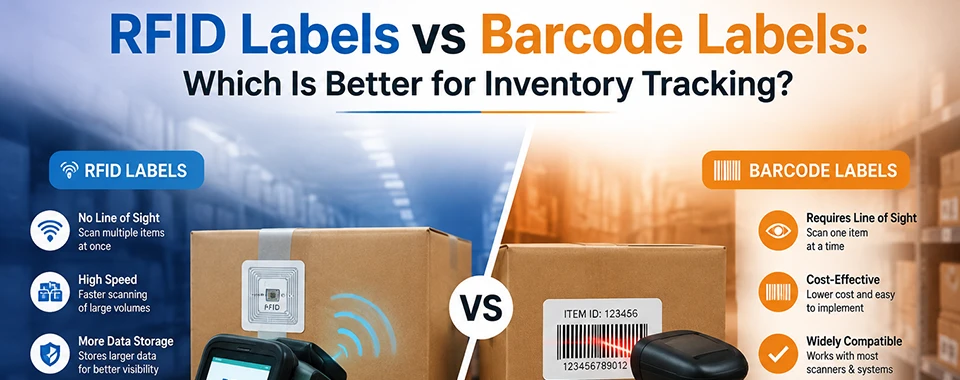
Barcode labels generally require the scanner to see the printed barcode. RFID labels use radio frequency communication, allowing compatible readers to identify tags without direct visual scanning.
2. Multiple-Item Reading
Barcode scanners generally process items individually unless specialised scanning systems are used. RFID technology can allow multiple tagged items to be identified within a reading area, which can improve efficiency in high-volume inventory environments.
3. Data Capacity
Traditional barcodes generally contain a limited amount of encoded information and often act as an identifier linked to a database. RFID tags can store additional electronic information depending on the tag type and system configuration.
4. Durability
Barcode labels can be produced using materials such as paper, polypropylene, polyester, and vinyl. RFID labels can also be designed with different label materials and constructions based on the application.
For demanding environments, businesses should select materials that can withstand moisture, abrasion, chemicals, temperature changes, or other conditions.
5. Cost and Implementation
Barcode systems are often simpler and more economical to implement, particularly for businesses with straightforward identification requirements. RFID systems may require RFID readers, antennas, software, and compatible tags, resulting in a higher initial investment.
However, RFID can provide operational benefits for businesses that require faster automated identification and tracking.
When Should You Choose Barcode Labels?
Barcode labels can be a suitable choice when businesses need a straightforward and cost-effective identification system.
They can work well for:
- General inventory management
- Product identification
- Retail operations
- Shipping and logistics
- Warehouse labelling
- Asset identification
- Manufacturing processes
- Applications where individual scanning is acceptable
Barcode technology is also widely supported by existing printers, scanners, and inventory management systems, making implementation relatively straightforward.
When Should You Choose RFID Labels?
RFID labels can be beneficial when businesses need greater automation or faster identification of large numbers of items.
They may be suitable for:
- High-volume inventory management
- Warehouse automation
- Supply chain tracking
- Asset management
- Manufacturing traceability
- Retail inventory visibility
- Automated stock counting
- Applications requiring non-line-of-sight identification
Businesses should evaluate their operational requirements before investing in an RFID system.
Can RFID and Barcode Labels Work Together?
Yes. RFID and barcode technologies do not necessarily have to be used separately. Businesses can combine both technologies to support different stages of their operations.
For example, an item can have a printed barcode for conventional scanning while also carrying an RFID inlay for automated identification. This approach can provide flexibility where different teams or processes use different tracking technologies.
Using both technologies can also support a gradual transition from traditional barcode systems to more automated RFID-based processes.
How to Choose the Right Inventory Tracking Solution
When comparing RFID labels vs barcode labels, businesses should consider several factors:
- Number of items being tracked
- Required scanning speed
- Need for automated identification
- Available infrastructure
- Operating environment
- Required data capacity
- Implementation budget
- Existing inventory software
- Required label durability
- Future scalability
For smaller or straightforward inventory operations, barcode labels may provide an efficient solution. For high-volume operations requiring greater automation, RFID labels may offer additional advantages.
Choosing the Right Label Supplier
Whether a business chooses barcode or RFID technology, selecting the right supplier is important. A capable supplier should be able to provide appropriate label materials, sizes, printing options, adhesives, and customisation based on the application.
Autopack provides label solutions for different industries and applications, including manufacturing, logistics, healthcare, retail, food and beverage, and industrial operations. Its solutions can support businesses with different identification and tracking requirements.
Conclusion
There is no universal answer to whether RFID labels or barcode labels are better for inventory tracking. Barcode labels remain a practical and cost-effective choice for many businesses, particularly where individual scanning is sufficient. RFID labels can provide greater automation and faster identification for high-volume inventory and tracking environments.
The best solution depends on your inventory size, workflow, scanning requirements, budget, operating environment, and future technology plans. In some cases, using RFID and barcode labels together can provide a flexible approach that combines traditional scanning with automated identification.
Choosing a supplier that understands different labelling technologies and industry requirements can also help businesses select the right solution for reliable inventory tracking and traceability.
Looking for the right RFID or barcode label solution for your business? Contact Autopackone to discuss your inventory tracking requirements and find a solution suited to your application.
Frequently Asked Questions
1. What is the difference between RFID labels and barcode labels?
Barcode labels use printed codes that are scanned optically, while RFID labels use radio frequency technology to communicate with compatible RFID readers. RFID can support identification without direct line-of-sight.
2. Are RFID labels better than barcode labels?
Not necessarily. RFID can be more suitable for high-volume and automated tracking, while barcode labels can be a practical and economical option for applications requiring individual scanning.
3. Can RFID labels replace barcode labels?
RFID can replace barcode-based identification in some applications, but the decision depends on infrastructure, budget, operational requirements, and system compatibility. Businesses can also use both technologies together.
4. Which is more cost-effective, RFID or barcode labels?
Barcode systems are generally simpler and can have lower implementation costs. RFID may require additional readers and infrastructure but can provide greater automation and efficiency in suitable applications.
5. Are RFID and barcode labels suitable for warehouses?
Yes. Both technologies can support warehouse inventory tracking. Barcode labels are widely used for individual product and location scanning, while RFID can support faster identification and automated inventory processes.
Improve Your Inventory Tracking With the Right Labels
The right identification technology can improve inventory accuracy, operational efficiency, and product traceability. Whether you need RFID labels, barcode labels, or a combination of both, selecting the right label material and technology is essential for reliable performance.
Contact Autopackone today to discuss your inventory tracking requirements and explore label solutions designed for your industry.
