




- July 20, 2026
- Latest News
“Should we use barcodes or RFID?” is one of the most common questions we hear from businesses evaluating a barcode and RFID solution upgrade. The honest answer is that it depends on your operation, not on which technology is objectively better.
Both barcode solution and RFID solution options solve the same core problem, accurate and fast data capture, but they do it very differently. Here is how to tell which one, or which combination, fits your business, drawing on Autopack’s own barcode and RFID technology lines.
The Core Technical Difference
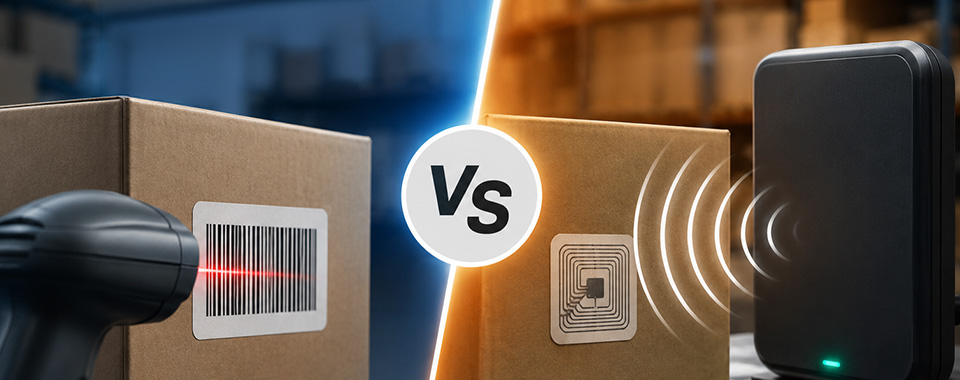
Barcode systems require direct line of sight scanning. A barcode scanner must see each barcode individually to read it, whether that is a handheld device or a fixed scanner on a conveyor line.
RFID systems use radio frequency signals. RFID tags can be read without direct line of sight, and RFID readers can capture multiple tags simultaneously, even dozens at once, within their read range.
This single difference drives most of the practical trade offs between the two automated data capture solutions.
Comparing Barcode and RFID Across Key Factors
Speed
Barcode scanning reads one item at a time, requiring the scanner to be pointed at each code. RFID tracking solutions can read multiple tagged items in bulk, dramatically speeding up processes like full pallet inventory counts.
Accuracy
Both technologies offer high accuracy, but RFID reduces the chance of missed reads on items that are stacked, boxed, or oriented awkwardly, since no direct line of sight is needed.
Cost
Barcode labels are typically far cheaper per unit than RFID tags. RFID readers, RFID antenna hardware, and RFID encoder equipment generally cost more upfront than a barcode scanner or barcode printer. Barcode remains the more economical choice for high volume, low value item tracking.
Range and Environment
RFID readers can detect tags from several meters away, useful for dock doors, gates, and large warehouse zones. Barcode scanning is limited to close range, direct scans, whether performed with a Zebra scanner or a Honeywell scanner.
Data Storage
RFID tags can store more data directly on the tag, including batch numbers, timestamps, and condition data, while barcodes typically link to a database record through a simpler code.
When Barcode Solutions Make More Sense
- High SKU volume with tight margins per unit
- Retail point of sale environments
- Simple traceability needs without bulk read requirements
- Budget conscious deployments
When RFID Solutions Make More Sense
- Large scale warehouse or yard inventory counts
- Asset tracking across wide facilities, such as construction sites or hospitals
- Applications needing bulk scanning without manual handling
- High value asset or equipment tracking where tag cost is justified by risk reduction
Can You Use Both?
Many businesses run hybrid systems: barcodes for individual unit level tracking, like retail SKUs, combined with RFID for pallet, container, or high value asset tracking. This hybrid approach to inventory tracking solutions balances cost efficiency with the scalability RFID provides at higher levels of the supply chain, an approach reflected in Autopack’s asset tracking and inventory control platform.
Real World Example
A logistics operator might barcode scan individual parcels at intake for unit level records, then use RFID gate readers at dock doors to automatically log entire truckloads as they pass through, without scanning each parcel again.
Making the Right Choice for Your Business
Before choosing, map out:
- Your current pain points in speed, accuracy, labor cost, and visibility gaps
- Your item volume and unit value
- Your facility layout and read range requirements
- Your budget for hardware and consumables
A technology consultation with an experienced provider can help you avoid overspending on RFID where barcode would suffice, or under investing in RFID where it would deliver clear ROI.
Frequently Asked Questions
- Is RFID always more expensive than barcode?
Generally yes, in terms of tag cost and reader hardware, though RFID often pays for itself through labor savings and reduced errors in high volume bulk scanning scenarios. - Can RFID replace barcodes entirely?
Not usually. Most businesses use RFID to complement barcode systems rather than fully replace them, since barcodes remain more economical for item level tracking. - Do RFID tags need batteries?
Passive RFID tags do not require batteries and are powered by the reader’s signal, making them cost effective for most inventory applications. Active tags do use batteries and offer longer read range. - How far can RFID readers detect tags?
Range varies by tag type and reader, but UHF RFID systems commonly read tags from several meters away, far beyond typical barcode scanning distance. - Which industries typically combine barcode and RFID?
Logistics, warehousing, retail, and manufacturing frequently combine both technologies to balance cost and scalability across different tracking needs.
Not Sure Which Technology Fits Your Operation?
Our team can assess your current workflow and recommend the right mix of barcode and RFID technology for your business. Schedule a free consultation to get started.
