




- July 21, 2026
- Latest News
Stock discrepancies, delayed cycle counts, and misplaced assets cost businesses far more than most realize, not just in lost inventory, but in the labor hours spent chasing down the problem. RFID inventory management software addresses this directly by giving businesses continuous, real time visibility into stock levels and asset locations, without manual scanning of every individual item. It is the same principle behind Autopack’s own asset tracking and inventory control system.
What Is RFID Inventory Management Software?
RFID inventory management software connects an RFID reader and RFID tags to a centralized platform that automatically updates stock records as tagged items move through readers, gates, or scanning zones. Instead of periodic manual counts, the system captures data continuously, turning inventory tracking from a scheduled task into an ongoing process, a form of inventory automation that scales with your operation.
Why Real-Time Tracking Matters
Manual Counting Cannot Keep Pace
Manual inventory counts are typically done weekly, monthly, or quarterly, leaving long windows where stock records do not reflect reality. This leads to stockouts, overordering, and shipment errors that only surface when it is too late to correct cheaply.
RFID Closes the Visibility Gap
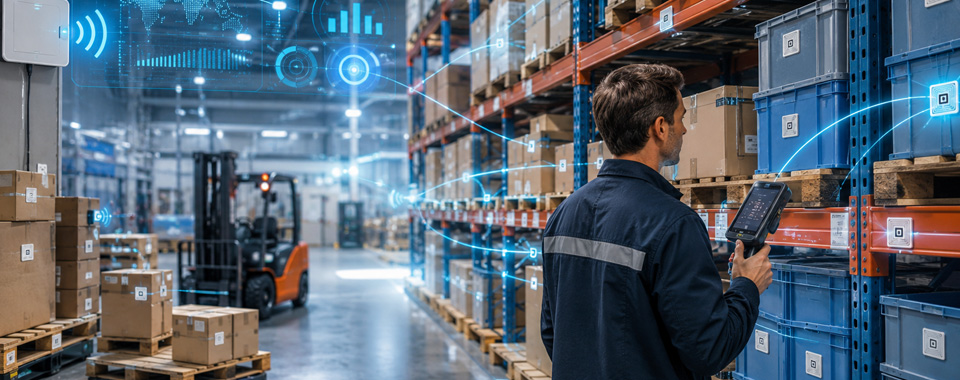
With an RFID inventory tracking system, items are read automatically as they move through dock doors, storage zones, or production stages, updating records within seconds, not days, using UHF reader infrastructure positioned at key checkpoints.
Core Benefits for Businesses
- Higher stock accuracy: bulk read RFID scanning eliminates the human error inherent in manual counts
- Faster cycle counts: full warehouse counts that once took hours can be completed in minutes with handheld or fixed UHF reader setups
- Reduced shrinkage: continuous visibility makes it easier to detect misplaced or missing stock quickly
- Labor cost savings: staff spend less time on manual counting and more time on higher value tasks
- Better demand planning: accurate, real time data supports smarter purchasing and replenishment decisions
Industry Applications
Manufacturing
RFID inventory management tracks raw materials, work in progress, and finished goods across production stages, supporting traceability and reducing production delays caused by missing components.
Logistics and Warehousing
Warehouse RFID solutions use dock door readers to automatically log inbound and outbound shipments, eliminating manual scanning at high traffic checkpoints and improving throughput. This is where Autopack’s warehouse management system ties directly into RFID infrastructure.
Healthcare
Hospitals use RFID asset tracking solutions to locate mobile equipment such as infusion pumps, wheelchairs, and monitors in real time, reducing time spent searching for critical devices.
Retail
Retailers use RFID inventory tracking for accurate stock counts across store and backroom locations, reducing out of stock situations that directly impact sales.
Key Components of an RFID Inventory System
- RFID tags applied to inventory items or assets
- RFID reader hardware, fixed or handheld, positioned at key checkpoints
- RFID antenna units to extend and shape read coverage
- Inventory management software that processes read data and syncs with your ERP or warehouse system
- RFID printer and RFID encoder equipment for programming and printing tag data during labeling
What to Look for in an RFID Inventory Solution
When evaluating providers, consider:
- Integration compatibility with your existing ERP or warehouse system
- Scalability across multiple warehouse zones or store locations
- Reporting and dashboard capabilities for real time visibility
- Ongoing technical support and system maintenance
- Proven deployment experience across similar industries
Getting Started with RFID Inventory Management
Most successful RFID rollouts start with a pilot zone, a single warehouse aisle, product line, or asset category, before scaling company wide. This allows businesses to validate RFID scanner performance, reader placement, and software integration before committing to a full deployment.
Frequently Asked Questions
- How much does RFID inventory management software typically cost? Costs vary widely based on scale, tag volume, and reader infrastructure needed, so most providers start with a site assessment to provide accurate, tailored pricing.
- Can RFID inventory systems integrate with my existing ERP? Yes, most modern RFID inventory management software is designed to integrate with common ERP and warehouse management platforms through APIs or middleware.
- How long does an RFID inventory rollout take? A pilot deployment can often be completed within a few weeks, with full scale rollout timelines depending on facility size and integration complexity.
- Is RFID inventory tracking suitable for small businesses? Yes, though ROI is generally strongest for businesses with higher inventory volume or high value assets where manual counting costs and errors are more significant.
- What industries see the fastest ROI from RFID inventory management? Logistics, warehousing, manufacturing, and healthcare typically see the fastest returns due to high transaction volume and the cost of manual counting errors.
Ready for Real-Time Inventory Visibility?
Stop relying on outdated stock counts. Talk to our team about a tailored RFID inventory management solution built for your operation. Request a free consultation today.
