




- August 24, 2026
- Latest News
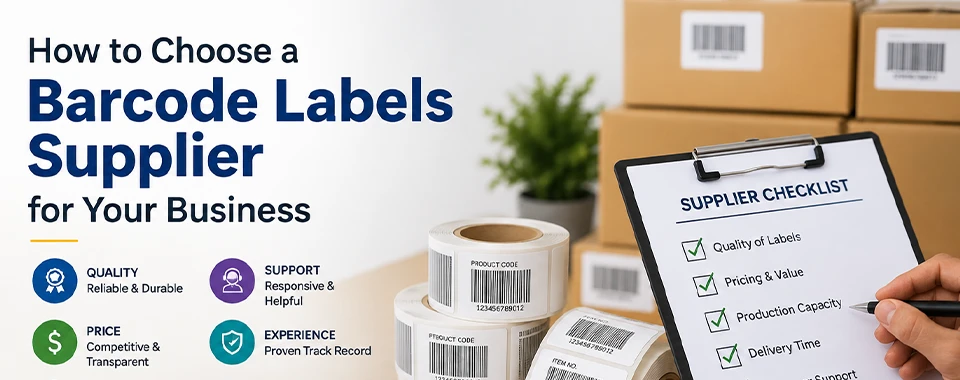
How to Choose the Right Barcode Labels Supplier for Your Business
Barcode labels are widely used for product identification, inventory management, warehousing, logistics, asset tracking, and supply chain operations. They allow businesses to capture product information quickly, reduce manual data-entry errors, and improve operational efficiency. However, choosing the right barcode labels supplier is essential to ensure consistent print quality, durability, readability, and compatibility with your printing system.
Different industries have different labelling requirements. The right solution depends on factors such as label material, adhesive, size, printing method, application environment, and required durability.
Why Choosing the Right Barcode Labels Supplier Matters
Not all barcode labels are suitable for every application. A label used for warehouse inventory may have different requirements from one used for outdoor equipment, healthcare products, or industrial assets.
A reliable barcode labels supplier should offer a range of materials, sizes, adhesives, finishes, and customisation options. High-quality labels can help maintain barcode readability and reduce issues such as fading, peeling, tearing, and scanning errors.
Choosing an experienced supplier also makes it easier to select labels that are compatible with your existing printers and suitable for your operational requirements.
Choose the Right Barcode Label Material
The label material should match the application and environment in which it will be used.
Paper labels are a cost-effective choice for general indoor applications, including retail, warehousing, logistics, and routine product identification.
Polypropylene (PP) labels provide improved durability compared with standard paper and can be suitable for applications where greater resistance is required.
Polyester (PET) labels are suitable for applications that require higher durability and resistance. They can be used for equipment identification, asset tracking, and demanding industrial environments.
Vinyl labels offer flexibility and durability and can be considered for applications where labels may be exposed to outdoor or challenging conditions.
A professional barcode labels supplier should provide different material options rather than offering a single solution for every application.
Check Barcode Printer Compatibility
Printer compatibility is another important consideration when selecting barcode labels. Businesses commonly use direct thermal or thermal transfer printing, and the label should be suitable for the chosen printing technology.
Before ordering, businesses should consider:
- Printer brand and model
- Printing technology
- Label dimensions
- Roll and core specifications
- Required print resolution
- Ribbon requirements
- Expected printing volume
Using compatible labels can help produce clear, consistent barcodes and support reliable scanning performance.
Consider the Application
Barcode labels are used across manufacturing, logistics, healthcare, retail, food and beverage, and other industries.
Common applications include:
- Inventory labels for products and stock management
- Shipping labels for logistics and fulfilment
- Asset labels for equipment identification
- Product labels for packaging and identification
- Healthcare labels for patient and specimen identification
- Laboratory labels for specialised environments
- Food and beverage labels for packaging and product information
- Shelf labels for retail identification
- Compliance labels for safety and certification information
- Outdoor labels for long-term industrial identification
Selecting labels based on the specific application can improve durability, readability, and overall performance.
Consider Custom Barcode Label Solutions
Standard labels may not always meet the requirements of a particular business. Custom barcode labels can be created according to specific operational and identification needs.
Depending on the application, customisation may include:
- Different label sizes and shapes
- Custom colours and finishes
- Company logos
- Variable data
- Sequential numbering
- Barcode formats
- QR codes
- Special adhesives
- RFID integration
Custom solutions can be particularly useful for manufacturers, warehouses, logistics companies, retailers, healthcare organisations, and businesses with specialised labelling requirements.
Evaluate Durability and Print Quality
Environmental conditions should always be considered before selecting barcode labels. Indoor warehouse applications may require standard paper labels, while outdoor or industrial applications may require materials with greater resistance to moisture, abrasion, chemicals, or temperature changes.
Print quality is equally important. A barcode needs to remain clear and readable for scanners to capture information accurately. Poor-quality materials or unsuitable printing combinations can lead to damaged or unreadable barcodes.
Selecting suitable materials and compatible printing systems can help maintain barcode readability throughout the intended life of the label.
Why Choose an Experienced Barcode Labels Supplier?
An experienced supplier can provide more than standard rolls of labels. They can help businesses identify the appropriate combination of material, adhesive, dimensions, finish, and printing technology.
Autopack provides label solutions for a range of industries and applications, including manufacturing, healthcare, logistics, retail, food and beverage, and industrial operations. Its solutions include different label materials and customisation options designed to meet varying identification and tracking requirements.
Working with a supplier that understands different industry applications can simplify the selection process and help businesses implement reliable labelling solutions.
Conclusion
Choosing the right barcode labels supplier is an important step for businesses looking to improve product identification, inventory accuracy, traceability, and operational efficiency. The right supplier should be able to provide suitable label materials, reliable print quality, printer compatibility, durability, and customisation options based on the specific application.
From paper labels for everyday indoor use to durable PP, PET, and vinyl labels for demanding environments, the ideal solution depends on where and how the labels will be used. Businesses should also consider printing technology, adhesive requirements, label size, barcode readability, and environmental conditions before making a decision.
With a range of materials, custom label solutions, and applications across manufacturing, logistics, healthcare, retail, food and beverage, and other industries, Autopack can support businesses with their labelling requirements.
Looking for a reliable barcode labels supplier for your business? Contact Autopackone to discuss your requirements and find the right label solution for your application.
Frequently Asked Questions About Barcode Labels
1. What should I look for in a barcode labels supplier?
Look for a supplier that offers different materials, sizes, adhesives, finishes, customisation options, printer compatibility, and technical support. The supplier should also be able to recommend labels based on your specific application.
2. What types of barcode labels are available?
Common barcode label materials include paper, polypropylene (PP), polyester (PET), and vinyl. The appropriate option depends on the application, environmental conditions, required durability, and printing method.
3. Can barcode labels be customised?
Yes. Barcode labels can be customised in different sizes, shapes, colours, and finishes. They can also include logos, variable information, sequential numbers, barcodes, QR codes, and specialised adhesives.
4. Are barcode labels suitable for manufacturing?
Yes. Barcode labels can be used for product identification, component tracking, inventory management, asset identification, and manufacturing traceability. Durable materials can be selected for demanding manufacturing environments.
5. Can barcode labels be used for inventory tracking?
Yes. Barcode labels provide machine-readable identification for products, cartons, storage locations, and assets. When combined with barcode scanners and inventory systems, they can help improve inventory accuracy and reduce manual data entry.
Choose the Right Barcode Label Solution
The right barcode label can make a significant difference to product identification, inventory accuracy, traceability, and daily operations. Whether you need standard paper labels, durable synthetic labels, or customised barcode solutions, selecting an experienced barcode labels supplier can help ensure reliable performance.
Looking for barcode labels for your industry? Contact Autopackone today to discuss your requirements and find a suitable labelling solution for your business.
