




- July 20, 2026
- Latest News
If your business still relies on manual stock counts or spreadsheets to track inventory, you are likely losing money to errors you cannot even see. Barcode solutions solve this by giving every item, pallet, or asset a unique, scannable identity, turning guesswork into real time data.
For decades, businesses across manufacturing, logistics, retail, and healthcare have used barcode technology solutions to speed up operations and eliminate costly mistakes. This guide breaks down what barcode solutions actually include, how they work together, and what to evaluate before you invest, including where Autopack’s own barcode technology fits into the picture.
What Are Barcode Solutions?
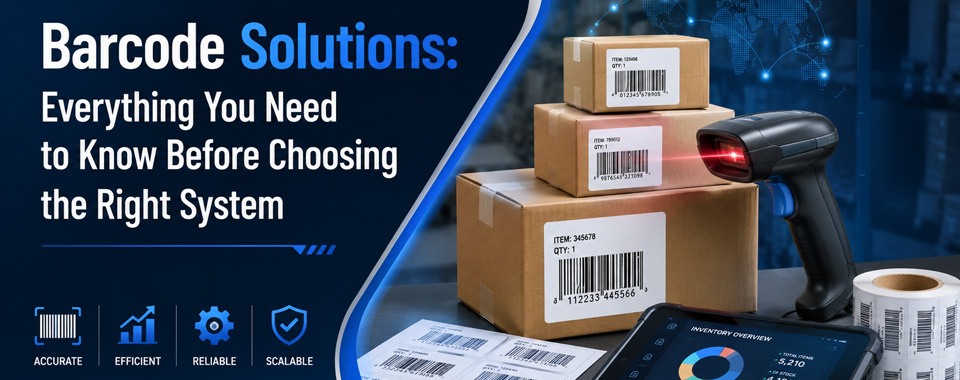
A barcode solution is not a single product. It is an ecosystem of hardware, software, and consumables working together as one barcode tracking system:
- Barcode scanner solutions: handheld, fixed mount, or wearable devices that read 1D and 2D barcodes, such as Zebra scanner and Honeywell scanner ranges, along with Datalogic scanner and Epson scanner models for lighter duty tasks
- Barcode printer solutions: desktop, industrial, or portable printers that produce labels on demand, including TSC printer and Zebra printer lines built for continuous production use
- Label software: design tools such as Seagull BarTender software for creating compliant, print ready barcode label solutions
- Consumables: label sticker stock, ribbons, and adhesives suited to your environment, whether cold storage, outdoor exposure, or high heat production floors
- Software integration: connecting scan data to your ERP, warehouse system, or point of sale platform, similar to the approach used in Autopack’s customized ERP integration
Each component needs to match your operational environment. A barcode printer running continuously on a factory floor has very different durability requirements than one used at a retail counter with a Sunmi POS terminal.
How Businesses Use Barcode Systems
Inventory and Warehouse Management
Barcode inventory management gives warehouses real time visibility into stock levels, locations, and movement. Instead of manual audits, staff scan items as they are received, moved, or shipped, cutting inventory discrepancies significantly. Systems like Autopack’s warehouse management platform build directly on this foundation.
Retail and Point of Sale
Retailers use barcode scanner solutions at checkout and on the shop floor for price verification, stock replenishment, and loss prevention, often paired with Sunmi POS hardware for a compact, all in one setup.
Manufacturing and Logistics
On production lines, barcodes track work in progress, batch numbers, and finished goods, supporting full traceability from raw material to shipped product. In logistics, barcode label solutions follow shipments from warehouse to last mile delivery.
Healthcare and ID Management
Hospitals use barcode systems for patient wristbands, medication tracking, and asset management, while an ID card printer such as the Zebra ZC300 or a Fargo printer handles staff and visitor credentials, much like the workflow behind Autopack’s ID card printing solution.
Key Hardware Considerations
When selecting barcode hardware, consider:
- Scan environment: rugged handheld scanners from Zebra, Honeywell, or Datalogic for warehouses versus compact scanners for retail counters
- Print volume and durability: industrial printers such as TSC or Zebra models for high volume, continuous operations versus desktop printers for lower volume needs
- Connectivity: Bluetooth, Wi-Fi, or wired options depending on your facility layout
- Label material: thermal transfer versus direct thermal, depending on how long labels need to last
- Software compatibility: whether the system integrates cleanly with your existing ERP or inventory platform
Barcode Solutions vs Manual Processes: The ROI Case
Manual data entry is slow and error prone. Industry estimates put manual keying error rates far higher than barcode scanning, which is typically over 99 percent accurate. Beyond accuracy, businesses see:
- Faster receiving and dispatch cycles
- Reduced labor cost per transaction
- Better audit trails for compliance
- Fewer stockouts and overstocking incidents
Choosing the Right Barcode Solution Provider
Not all providers are equal. Look for a barcode solution provider that offers:
- Multi brand hardware options, not locked into one manufacturer
- On site consultation to assess your actual workflow
- Integration support for ERP and warehouse systems
- Local after sales service, maintenance, and access to consumables like ribbons and label stock
A provider with decades of hands on deployment experience across different industries, rather than a pure reseller, can help you avoid costly mismatches between hardware and use case.
Frequently Asked Questions
- What is the difference between 1D and 2D barcodes? 1D barcodes store limited data read in one direction, like standard retail barcodes, while 2D barcodes such as QR codes or Data Matrix store more information and can be read in any orientation, even if partially damaged.
- How long does barcode hardware typically last? Industrial grade scanners and printers from brands like Zebra or Honeywell are built for years of continuous use, while consumer grade equipment may need replacement much sooner under heavy use.
- Can barcode systems integrate with my existing ERP software? Yes. Most modern barcode solutions integrate with popular ERP and warehouse management platforms through APIs or middleware, allowing scanned data to update inventory records in real time.
- Is barcode technology still relevant compared to RFID? Absolutely. Barcodes remain more cost effective for many applications, especially where line of sight scanning is practical and per unit costs need to stay low.
- What industries benefit most from barcode solutions? Manufacturing, logistics, retail, and healthcare see the most impact, though any business tracking physical inventory or assets can benefit.
Ready to Upgrade Your Barcode System?
Choosing the right combination of scanners, printers, and software should not be guesswork. Talk to our team for a free consultation and a tailored barcode solution recommendation for your operation. Request a demo today.
