




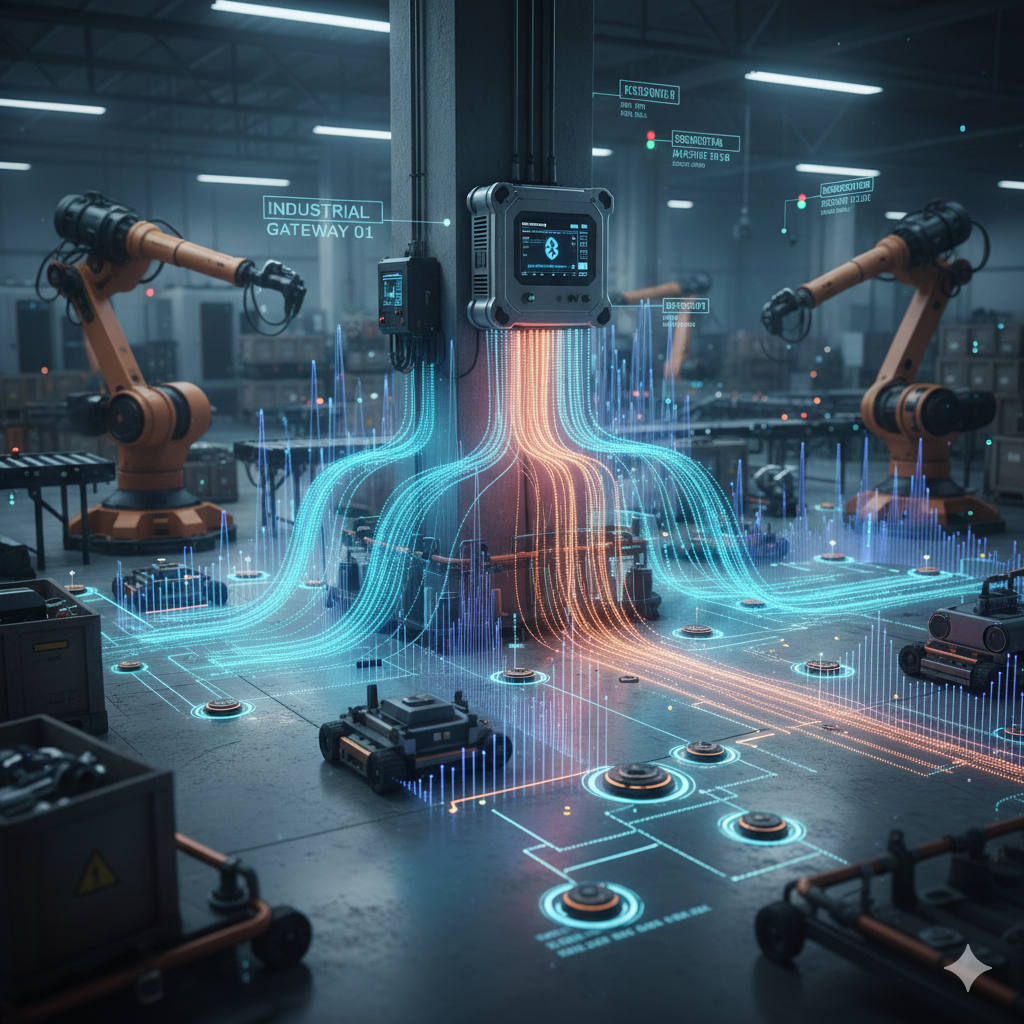
Bluetooth Low Energy (BLE) Overview
Bluetooth Low Energy (BLE) is a power-efficient wireless communication technology designed for the modern industrial landscape. Unlike classic Bluetooth, BLE is optimized for short bursts of data, allowing devices to operate for years on a single coin-cell battery. For Autopack, BLE serves as a foundational pillar for “Connected Machines,” enabling real-time asset tracking, condition monitoring, and seamless integration between the factory floor and business management systems.
Features of Bluetooth Low Energy (BLE)
Universal Compatibility
Since BLE is native to almost every modern smartphone and tablet, your existing mobile devices can act as scanners, reducing the need for specialized hardware.
Cost-Effective Scalability
BLE infrastructure is significantly more affordable than traditional RFID portals, allowing for dense coverage across large warehouses or manufacturing plants.
Unmatched Battery Life
Devices spend most of their time in "sleep mode," waking only for milliseconds to transmit data, which ensures long-term reliability without manual intervention.
Precise Indoor Positioning
BLE supports advanced techniques like Angle-of-Arrival (AoA) to locate assets with sub-meter accuracy in environments where GPS signals fail.
Secure Mesh Networking
Support for BLE Mesh allows devices to relay messages to one another, extending the range across vast facilities without needing a gateway for every sensor.
Adaptive Frequency Hopping
BLE automatically hops between 40 channels to avoid interference from Wi-Fi and other 2.4 GHz signals, ensuring robust data transmission in "noisy" industrial environments.
High Data Reliability
Small packet sizes and rapid handshakes minimize data loss even when signal strength is marginal or objects are in motion.
Multi-Sensor Integration
BLE tags don't just track location; they can embed sensors for temperature, vibration, and humidity to provide a "health check" for both products and machinery.
Implementation of Bluetooth Low Energy (BLE)
-
1. Site AuditOur team assesses your facility for potential interference and identifies optimal gateway placement.
-
2. Tag Provisioning:BLE tags are configured with unique IDs and sensor thresholds tailored to your specific assets.
-
3. Gateway InstallationLow-profile gateways are installed at key transition points or in a mesh grid for total floor coverage.
-
4. Software SyncWe connect the BLE network to your existing ERP or Warehouse Management System (WMS)
-
5. Testing & OptimizationReal-time location accuracy is calibrated to ensure seamless tracking and alerting.

Contact us to find out more
Use Cases of Bluetooth Low Energy (BLE)
-
Cold Chain Monitoring for PharmaceuticalsThin BLE labels on pallets monitor temperature throughout transit, providing a time-stamped log to ensure compliance with strict medical regulations.
-
Real-Time Tool & Equipment TrackingLocate expensive industrial tools or mobile forklifts instantly within a large facility, reducing "search time" and improving asset utilization.
-
Automated Inventory CountingUnlike barcodes that require line-of-sight, BLE beacons allow a manager to walk through a warehouse and automatically update inventory levels via a tablet.
-
Safety & Access ControlBLE-enabled ID badges can trigger safety shut-offs if a worker enters a hazardous zone near automated machinery or provide hands-free access to secure areas.
Frequent Asked Questions on Bluetooth Low Energy (BLE)
-
What is the main difference between BLE and regular Bluetooth?BLE is designed for very low power consumption and infrequent data bursts, whereas regular Bluetooth is intended for continuous high-data streaming like audio.
-
How long does a BLE tag battery last?Depending on the broadcast frequency (ping rate), a standard coin-cell battery can last anywhere from 2 to 5 years.
-
Can BLE work around heavy metal machinery?Yes. While metal can reflect signals, BLE uses adaptive frequency hopping and mesh configurations to find the most reliable path for data.
-
Is BLE secure for industrial data?Absolutely. BLE uses AES-128 encryption and secure pairing processes to ensure data remains private and protected from eavesdropping.
-
Do I need a special reader to see BLE data?No. Most modern smartphones, tablets, and many Wi-Fi routers can detect and process BLE signals natively.
-
Can I track individual items or just pallets?Both. With the advent of "ambient IoT" and thin BLE labels, you can now track individual high-value items cost-effectively.
-
How many devices can a single gateway handle?Modern BLE gateways can typically manage hundreds of simultaneous connections or thousands of "advertising" beacons.
-
Does BLE interfere with my warehouse Wi-Fi?No. BLE is designed to coexist with Wi-Fi by using "advertising channels" that sit between standard Wi-Fi channels to prevent congestion.
-
Is BLE better than RFID?It depends on the use case. BLE is superior for real-time, long-range "always-on" visibility, while passive RFID is better for high-volume, low-cost "point-of-scan" identification.
